.svg)
Key Takeaways
- Substantial completion is the milestone at which an owner can use the building for its intended purpose, triggering a series of financial and contractual events for subcontractors.
- The determination of substantial completion is typically made by the architect, engineer, or owner's representative — not by the general contractor or subcontractor.
- Substantial completion starts the clock on final payment timelines, retainage release, and the statute of limitations for defect claims.
- Subcontractors should request the certificate of substantial completion in writing to establish a clear, documented date for payment and lien deadline purposes.
Substantial completion is one of the most important (and misunderstood) milestones in commercial construction. For subcontractors, it’s the moment when your work is recognized as functionally finished, triggering a series of financial and contractual events.
In theory, substantial completion seems simple enough. In reality, it can be a mess. What should be a clear milestone can turn into a drawn-out fight over definitions, leaving subs stuck waiting for their final payment.
This guide breaks down what substantial completion in construction means, how it impacts subcontractors, and what you can do to protect your payments (and your sanity) when the milestone hits.
What is substantial completion?
Substantial completion is the point at which a project (or a clearly defined portion of it) is finished enough for the owner to occupy the space or begin using it as intended legally.
Though the job might not be 100% done, it does mean that:
- Major building systems (electrical, plumbing, HVAC) are complete,
- Building and safety regulations are up to code, and
- The space is functional, even if cosmetic or minor punch list items remain.
This is often the first step in the construction closeout process.
What does substantial completion mean to subcontractors?
For subcontractors, reaching substantial completion sets several important processes in motion:
Financial Implications
- Partial or full release of retainage (depending on your contract)
- Deadline for submitting final pay applications
- Shift in billing responsibilities from field teams to project administrators
Legal and Warranty Implications
- Start of warranty periods for your work
- Beginning of statute of limitations for certain claims
- Transfer of liability from certain building systems to the owner
Operational Implications
- Your field crews can move on to the next project
- Administrative project closeout begins
- Lien deadline calculations may start
Understanding these triggers is crucial because the GC or owner can declare substantial completion suddenly, leaving subs scrambling to meet deadlines or make changes for which they weren’t prepared.
How is substantial completion determined?
The basic test for substantial completion is simple: can the owner use the building for its intended purpose? The actual determination gets made by someone with authority—typically the architect, engineer, construction manager, or owner's representative. They’ll walk through the project, assess functionality, document any remaining work in the punch list, and issue a certificate of substantial completion if the project passes inspection.
If the certificate of substantial completion is not signed, the countdown for receiving your final payment may not start. Granted, this is the standard process, but it might not always work this way. Which leads us to…
When does substantial completion cause problems?
Your contract should spell out the specifics, but many can leave this process vague, creating room for disputes over two main areas:
1. Who gets to decide when it happens and how?
Different projects handle this differently. Some GCs treat substantial completion as their call, and more like a flexible checkpoint they can declare when convenient. Others defer to the owner or architect, who might have stricter standards or different priorities. On public jobs, you might need an agency’s approval, which could add weeks to the process.
2. How does it get documented?
The standard process involves issuing a Certificate of Substantial Completion. Some projects treat this as a rigorous process requiring the architect's sign-off, formal inspections, and complete documentation before the certificate gets issued. Others are more informal, with the GC or project manager simply declaring substantial completion without proper certification.
The problem? You could have the same scope of work on three different projects and get three completely different timelines and requirements based on a) what the definition of substantial completion is in your contract, and b) who's making the call.
Certificate of Substantial Completion vs. Substantial Completion Letter
While we've been talking about the certificate of substantial completion as the standard documentation, you might also encounter a "substantial completion letter" or similar informal documentation. Here's how they differ:

And here’s why it matters: A letter or email saying "we've reached substantial completion" does not have the same effect as a signed certificate. If your contract references formal certification procedures, an informal letter may not be enough to start your payment countdown or retainage release.
Example
You’ve wrapped your work on a multi-tenant retail center. The GC sends you an email saying, “Project has reached substantial completion as of today.” Sounds official enough, right? You take it as a green light, move your team to the next job, and submit your final pay app.
Two weeks later, nothing. When you follow up, the GC says, “We're still waiting on the architect to issue the formal Certificate of Substantial Completion. That email was just our internal notice.” Turns out your contract specifically requires an AIA® G704 Certificate of Substantial Completion to trigger final payment terms. The architect won't sign off because the owner is disputing several punch list items.
You’re now 45 days behind on a $120K payout because you mistook the informal letter for proper certification.
The lesson? Always confirm what type of documentation your specific contract requires, and don't let informal communications substitute for proper certification when money is on the line.
What’s the difference between substantial completion and final completion?
Knowing the difference between substantial completion and final completion is critical for subcontractors. While these two milestones are often confused, they have different implications for payment timing, paperwork, and warranty obligations.
As mentioned, substantial completion kicks off the closeout process. Your fieldwork is done, but administrative tasks begin: warranty periods start, final pay app deadlines activate, and you might get partial retainage release.
Final completion is the true finish line. All punch list items are resolved, final documentation is approved, and remaining retainage is released. This is when the project officially closes out.
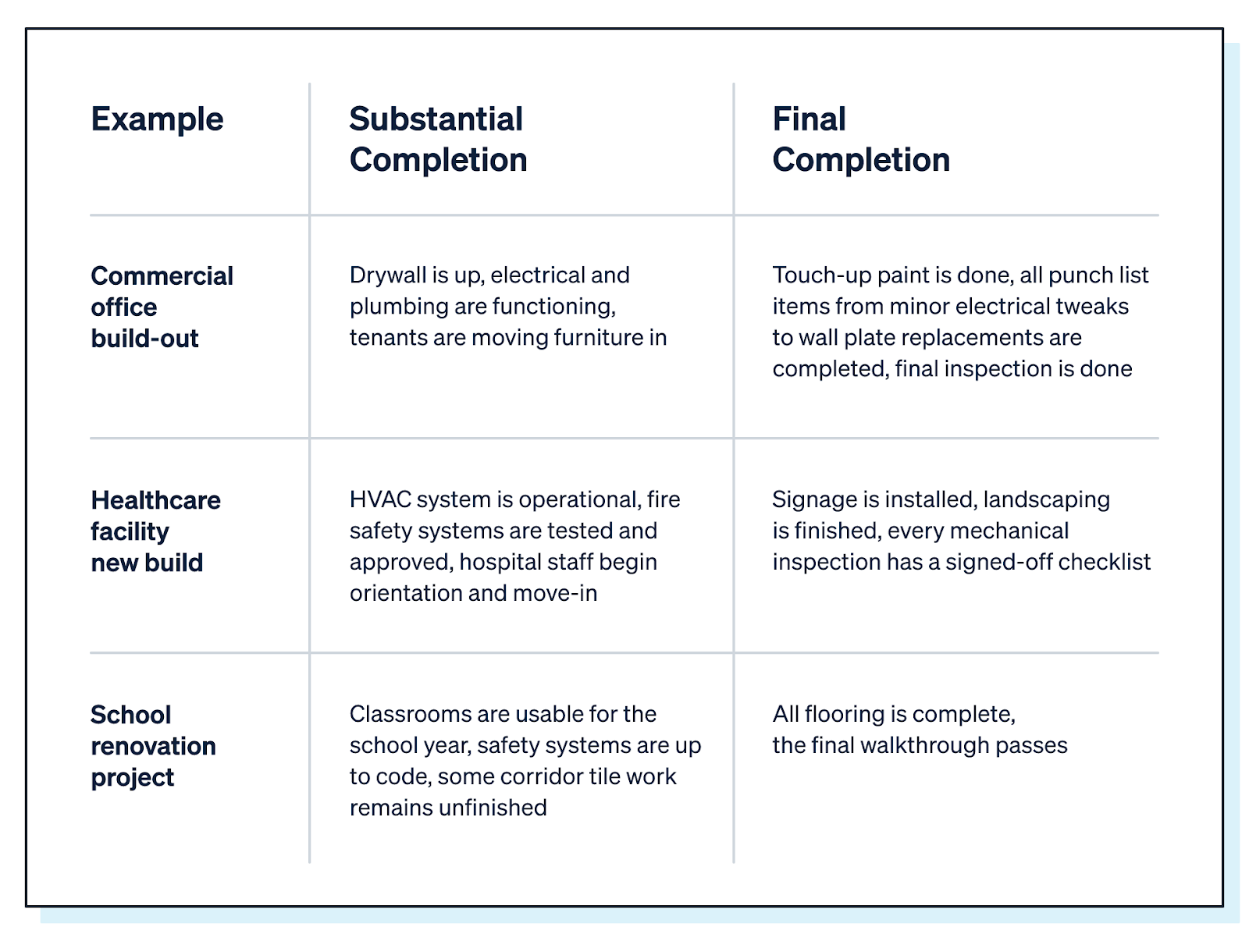
In short, substantial completion gets your final payment process started, but final completion gets you paid in full.
How can subcontractors stay ahead at substantial completion?
Substantial completion is one of the most misunderstood milestones in commercial construction, and one of the easiest places to fall behind.
Here’s how to stay ahead and avoid common pitfalls:
1. Know what triggers substantial completion before it happens.
If you’ve read up to this point, this tip should come as no surprise. As we mentioned, every project handles substantial completion differently. Before you’re anywhere near reaching it, make sure you understand:
- How is substantial completion defined in your contract
- Who has the authority to declare it
- What documentation is required
- Whether retainage is tied to this milestone or final completion
- When warranty periods and payment timelines start ticking
If anything is unclear, talk to your GC or project lead as soon as possible, or request clearer language in the contract if you’re still in negotiation. The earlier you clarify expectations, the fewer surprises you'll deal with later.
2. Track your own completion milestones—not just the GC’s.
Don’t wait for someone to tell you your work is done. Track your own progress toward substantial completion:
- Confirm when your scope reaches 95-99% completion
- Document progress with photos and internal logs
- Proactively flag and escalate punch list items
This ensures you’re prepared for it when the time comes.
3. Get your paperwork in order ahead of time.
The days immediately after substantial completion are often a scramble. Don’t wait to start organizing closeout materials.
Be ready to submit final pay applications, lien waivers, compliance documents from lower-tier vendors, and any other scope-specific deliverables. Pro tip: Use a solution like Siteline to keep all these billing documents organized and up-to-date.
4. Stay engaged throughout the closeout process.
Once your work wraps, it’s tempting to move your team to the next job and check out mentally. Stay involved to avoid delays and demonstrate you’re a reliable partner:
- Follow up consistently on punch list progress and certificate status
- Keep lines of communication open with the GC or the owner’s rep
- Confirm in writing when key milestones (like walkthroughs or sign-offs) occur
- Monitor closeout timelines and be ready to jump in if something stalls
Ready to streamline substantial completion?
Getting to substantial completion should feel like a win. But for subcontractors, it often signals a pileup of paperwork: final pay apps, lien waivers, CO reconciliations, and last-minute compliance docs all land at once, requiring your attention to move payments forward.
Siteline helps subcontractors stay organized and on schedule so nothing slips through the cracks.
With Siteline, you can:
- See exactly what’s due and when
- Automate final lien waivers for you and your lower tiers
- Stay ahead of change orders and compliance requirements
- Track pay app status in real time
Start closing out jobs without the back-and-forth. Check out Siteline here.
Substantial Completion FAQs
We’ve covered all the details above, but if you’re just looking for the quick and dirty version, here’s a roundup of the most common questions we hear about substantial completion:
Q: What does substantial completion mean in construction?
A: Substantial completion means the project is finished enough to be used for its intended purpose, but some final items may remain.
Q: What’s the difference between substantial completion vs. final completion?
A: Substantial completion means it’s usable; final completion means it’s 100% done and all paperwork is in.
Q: What is a certificate of substantial completion?
A: A formal document issued by the architect or GC that confirms the substantial completion date.
Q: When does the substantial completion date matter?
A: It kicks off warranty periods, impacts final pay timelines, and may affect retainage release.
Q: What is a substantial completion letter?
A: A less formal notice, typically issued when a certificate isn’t part of the contract.
AIA®, G702®, and G703® are registered trademarks owned by The American Institute of Architects and ACD Operations, LLC. Siteline is not affiliated with The American Institute of Architects or ACD Operations, LLC. Users who wish to use Siteline’s software to assist in filling out AIA® forms must have or secure the AIA® forms. Siteline does not and will not provide users with the forms.


%202.webp)