.svg)
Key Takeaways
- A 15% margin project can still harm a subcontractor's business if the payment cycle stretches 90 days — payment speed matters as much as margin for cash flow health.
- The difference between fast-paying and slow-paying clients can determine whether a subcontractor makes payroll or struggles to cover materials mid-project, regardless of contract size.
- Fast-paying GCs tend to also run more organized operations — cleaner change order processes, fewer documentation surprises — creating compounding benefits for subcontractors who prioritize them.
- Payment timing should be evaluated alongside margin, scope, and client relationship when subcontractors assess whether to pursue a bid or renegotiate contract terms.
Would you take a 15% margin job if it meant waiting 90 days to get paid? What if that extended payment cycle actually costs you more than what the project earned?
Margins aren’t always the whole story. Many subcontractors land projects with healthy profit percentages, only to find themselves struggling to make payroll or cover materials. That squeeze usually comes down to one overlooked factor: payment speed.
Regardless of who you’re working for, payment timing can be just as important as project size, margin, or client relationship. In fact, the difference between fast-paying and slow-paying clients can quietly determine whether your business grows—or grinds to a halt.
The Hidden Cost of Slow Payments
Here’s the big thing to remember: payment speed doesn’t just influence when money arrives—it changes how much profit you keep.
On the surface, two projects with the same margins can look equally profitable. But stretch out the payment timeline, and those numbers start to tell a very different story.
Take a look at this side-by-side comparison:
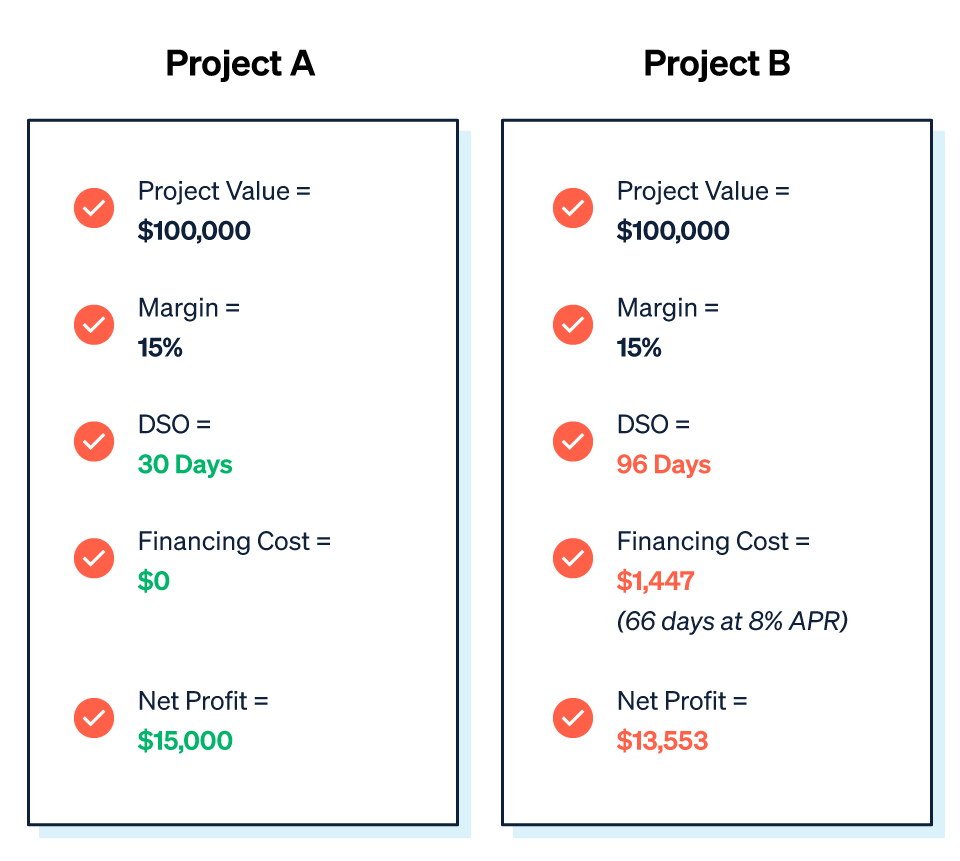
Both Project A and Project B are $100,000 jobs with a 15% margin. On paper, that’s $15,000 profit each. But once you factor in delayed payment on Project B, here’s what really happens:
- With a DSO of 96 days (the industry average for subcontractors), you’re forced to cover payroll, materials, and overhead without that cash in hand.
- Bridging the 66-day financing gap at 8% APR costs you about $1,447.
- Net profit drops to $13,700—nearly a 10% haircut on what looked like the same job.
And that’s just one project. Over the course of a year, slow payments can quietly erode tens—or even hundreds—of thousands in profit, while tying up capital that could fund new work or forcing you to rely on costly financing to stay afloat.
The Advantage of Fast-Paying Clients
Working with reliable, fast-paying GCs pays off in more ways than one. Sure, it keeps your cash flow healthier—but it also tends to signal how they run their jobs. Contractors who pay quickly often have more organized operations overall, which means less back-and-forth on change orders, cleaner documentation, and fewer surprises during the project.
There’s another ripple effect, too: your supplier relationships. When you can count on money coming in on time, you can negotiate better terms with vendors and even take advantage of early-payment discounts. Over time, that reliability builds trust, which can mean preferred pricing or priority service when demand spikes.
Evaluating Your Current Client Mix
If cash flow often feels tight, start by looking at who you’re working with. Don’t just rely on what the contract says—dig into actual payment patterns. You may find that a client who looks profitable on paper costs you far more once you factor in the drag of slow payments.
1. Regularly track payment speed.
Calculate the average time-to-payment for each GC you work with. And don’t stop when the money lands in your account. Track the entire cycle: invoice submission, approval, check run, and deposit. Some GCs are fast at approvals but slow to cut checks. Others are the reverse. Either way, these patterns matter.
Understanding where the bottlenecks are helps you forecast cash flow more realistically, spot trouble early, and prioritize the clients who actually keep your business running smoothly.
2. Benchmark against industry data.
Once you know your clients’ payment speed numbers, compare them to the rest of the industry. Our Top 50 Fastest-Paying GCs report gives you a clear picture of how your clients stack up. If you see that your “best” client is actually a laggard compared to the market, it may be time to rethink your bidding strategy.
3. Build a payment-weighted scoring system.
As we’ve established, margins alone don’t tell the whole story. A GC that pays in 25 days with 12% margins may actually contribute more to your business than one offering 18% margins but dragging payments out to 75 days. Once you factor in financing costs and lost opportunities, the “higher-margin” client might be worth less than they appear.
That’s the thinking behind a simple payment-weighted scoring system. Instead of ranking clients only by revenue or profit, you also assign value to how quickly they pay, giving you a truer picture of which clients strengthen your business.
Of course, no one has time to crunch these numbers by hand. Siteline brings the data together so you can see it all without extra work. With 360-degree visibility into your project portfolio—billing status, collections data, and change order approvals all in one place—you can quickly spot which clients are consistently tying up your cash and which ones keep it flowing. With that insight, it’s easier to prioritize bids, negotiate terms, and build a healthier client mix.
Diversifying Your Portfolio for Stability
Every subcontractor’s client mix looks a little different, and the right approach depends on your business goals. The point isn’t to work only with the fastest-paying clients—it’s to build a portfolio that balances profitability with cash flow stability.
A smart approach is to prioritize clients who combine speed with reliability. A GC who consistently pays in 50 days is often more valuable than one who promises 30 but averages 75. Over time, steady and predictable beats inconsistency.
It also helps to mix in smaller, quick-turn projects. Even with slimmer margins, those jobs can put cash in the bank faster and help cover expenses while you wait for larger payments to come through. That balance gives you more accurate cash flow forecasts, more flexibility in your operations, and less reliance on outside financing.
Deepening Relationships With Quality Payers
Once you’ve identified GCs with strong payment habits, lean into those relationships. Fast-paying clients are looking for subcontractors they can count on, and that dependability often leads to repeat work.
You might even consider offering slight pricing perks to the very best payers. A small discount for a client who pays in 20 days could be more profitable in the long run than chasing full price from one who drags payments out to 80.
Beyond pricing, open communication is key. Regular check-ins about change orders, approvals, and payment processes keep everyone aligned and help prevent delays. A proactive approach strengthens trust, smooths projects, and keeps your cash moving.
Steady Payments, Strong Cash Flow, Sustainable Growth
Subcontractors who factor payment reliability into their client decisions are simply better positioned—especially when the market tightens. When interest rates rise or credit gets harder to secure, steady inflows give you the confidence to keep bidding, staffing, and growing while competitors are stuck chasing overdue checks.
That’s where Siteline makes a difference. By giving subcontractors visibility into billing status, collections, lien waivers, and change order approvals—all in one place—you can see which clients are strengthening your cash flow and which ones are slowing it down. On average, Siteline users get paid 44% faster than the industry average, turning what once felt like a constant squeeze into an opportunity to plan ahead, invest in growth, and build stronger client relationships.
Interested in learning more? Get to know Siteline here.
AIA®, G702®, and G703® are registered trademarks owned by The American Institute of Architects and ACD Operations, LLC. Siteline is not affiliated with The American Institute of Architects or ACD Operations, LLC. Users who wish to use Siteline’s software to assist in filling out AIA® forms must have or secure the AIA® forms. Siteline does not and will not provide users with the forms.


%202.webp)