.svg)
Key Takeaways
- The 2026 State of Subcontractor Billing Report surveyed nearly 500 construction finance professionals on subcontractor billing, late payments, retainage, lien rights, and payment workflows.
- 92% of subcontractors floated payroll while waiting to get paid last year, and 59% said it typically takes 46 days or longer to receive payment.
- Retainage remains a major cash flow challenge: 43% of subcontractors wait more than 90 days for final payment, compared to just 15% of general contractors.
- 56% of subcontractors have missed a critical lien deadline in the past two years, highlighting the risks of managing lien rights with manual processes.
- Despite these challenges, 73% of subcontractors are optimistic about their financial outlook, and 56% plan to invest in billing technology.
Whenever I have a big decision to make about our business, one of the first things I do is go looking for a benchmark. As a co-founder, I'm always asking how other companies at our stage are handling something—what they're tracking, where they're ahead of us, where we need to catch up. It’s one of the most useful things you can do as a business leader.
The problem for subcontractors is that those benchmarks barely exist. And the ones that do usually aren't built for them. Seeing how a GC handles billing tells a sub almost nothing—the leverage and the risk are completely different. So subs are left guessing whether the friction they deal with every day is a them problem or an everybody problem.
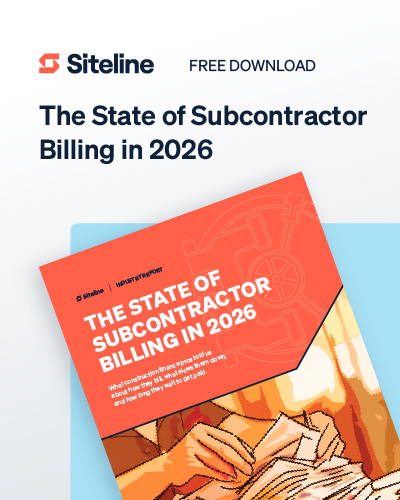
That's why we put together our State of Subcontractor Billing report. This spring, we surveyed nearly 500 construction finance and operations pros to put real numbers behind something most subs already feel in their gut but have never seen laid out.
The billing process is backwards—and it's not just you.
If there's one thing I hear again and again from subcontractors, it's that getting paid takes forever. You do the work first, you carry the cost, and the money shows up months later—if you're lucky. When you're in that spot, it's easy to assume you're the one doing something wrong.
You're probably not. According to our report, 92% of subcontractors floated payroll in the past year while waiting to get paid. Subs have basically become the industry's bank—except they're lending without any of the protections a real bank gets.
It all starts with how long it takes to get paid. Fifty-nine percent of subs say they wait 46 days or longer to get paid, with the industry average still hovering around 90 days. Retainage is where it gets really lopsided, with 43% of subs waiting more than 90 days to collect it, compared to just 15% of GCs. Same job, same dollars, but a completely different wait. That's how the chain was built—the party with the least leverage waits the longest, and that's almost always the sub.
So if you've ever looked at your A/R and figured you must be mismanaging something, this report should take some of that off your shoulders. It's an industry-wide problem, and calling it that is the first step to actually doing something about it.
Benchmarks only matter if you act on them.
A benchmark that just says "everyone's struggling" isn't worth much. When I look at other companies' numbers, it's to figure out where to spend my time. So the more useful question the report gets at is: of everything slowing subs down, what can you actually control?
And the answer is, more than you'd think. When we asked subs to rank the internal factors that most often delay their payments, the top offenders were pay app errors, disputed change orders, missing compliance docs, and lien waiver headaches—all within your control and all fixable.
The reason errors keep happening is that, for most subs, billing is still done by hand. Per the report, 67% spend 11 or more hours a month just preparing and tracking pay apps, most of them still running the whole thing on spreadsheets and email. That's how good work turns into rejected pay apps and rework.
Of all the stats, this one stuck with me most: 56% of subs have missed a critical lien deadline in the past two years. The deck is already stacked so high here—lien laws differ in every state, the deadlines are unforgiving, and keeping track of them all by hand is genuinely difficult. We all accept that construction is the slowest-paying industry there is. But losing the right to get paid at all because of a paperwork slip doesn’t sit right with me. Seeing that statistic reinforced something I’ve believed for a long time: subcontractors need a source they can trust on ever-changing lien laws, along with tools that help ensure nothing slips through the cracks.
The good news is this doesn’t need to be solved by hiring more people. Seventy percent of subs say their team already has the capacity to keep up. What's missing is a clear view of where every dollar (or lien deadline) sits. Give a team that already has the bandwidth that kind of view, and they can get a lot more done. That's why we didn't just dump a pile of stats into the report; we included a set of practical best practices any sub can put to work, whether or not they ever talk to us.
Here’s what I hope you take from it.
We didn't want this to be a report you skim once and forget. We wanted it to do for a sub what a good benchmark does for any operator: show you where you actually stand, remind you the hard parts aren't yours alone, and point you toward what to fix first.
The stats might be grim, but subcontractors are gritty and aren't giving up. Seventy-three percent feel good about their financial outlook, and 56% are planning to invest in billing technology. And it seems to pay off: subs using purpose-built billing software were more likely to get paid in under 46 days (44% vs. 37%), and a lot more are likely to feel confident about their lien rights (54% vs. 43%).
We can't say the software alone are helping close these gaps, but the pattern's hard to ignore. The subs who get paid fastest aren't the ones who chase the hardest. They're the ones who stopped running the most important part of their business out of a spreadsheet. You did the work, after all. You shouldn't have to bankroll it, too. And that’s the whole reason we do what we do—to protect subcontractors and help them walk the cash-flow tightrope they're forced to walk every day.
If you want the full picture—the findings, the benchmarks, and the best practices behind them—the report is right here. And if you're ready to stop being the bank, that's exactly what we built Siteline for.
AIA®, G702®, and G703® are registered trademarks owned by The American Institute of Architects and ACD Operations, LLC. Siteline is not affiliated with The American Institute of Architects or ACD Operations, LLC. Users who wish to use Siteline’s software to assist in filling out AIA® forms must have or secure the AIA® forms. Siteline does not and will not provide users with the forms.


%202.webp)