.svg)
Key Takeaways
- A mechanic's lien is a legal claim against a property that gives subcontractors, suppliers, and laborers leverage—by clouding the title and blocking a sale or refinance—to collect on unpaid work.
- Before you can file, most states require a preliminary notice sent early in the project. Skip it, and you can forfeit your lien rights before a payment problem ever surfaces.
- Filing follows a similar process nationwide: confirm eligibility, gather project details, complete the correct state-specific form, notarize it if required, record it with the county, and serve the required parties.
- Three separate clocks govern your lien rights: the notice deadline, the filing deadline, and the enforcement deadline. Miss any one, and you can lose your claim entirely.
- Deadlines and requirements vary significantly by state, so always confirm the current rules where your project is located before relying on general guidance.
Filing a mechanic's lien is often the fastest way to get an unresponsive general contractor (GC) or owner back on the phone—because once it's recorded, the owner can't sell or refinance until the debt is resolved.
While mechanic’s liens represent genuine leverage that most subcontractors, suppliers, and laborers already have the legal right to use, the process doesn't forgive mistakes. Miss a preliminary notice, file with the wrong county, or blow through a state deadline, and you can lose your lien rights entirely, sometimes before a payment problem even shows up.
This guide covers how to file a mechanic's lien step by step, the notices you need to send before you get there, and the deadlines that decide whether your lien holds up.
What is a mechanic's lien, and who can file one?
A mechanic's lien is a legal claim filed against a property when a contractor, subcontractor, supplier, or laborer hasn't been paid for labor or materials furnished on a construction project. Nearly everyone on the job can use one, including GCs, subs, lower-tier subs, material suppliers, and equipment lessors, so long as they follow the state's specific requirements. Once recorded, it clouds the property's title, which is what makes it such effective leverage: lenders won't close a refinance, title companies won't issue clean title insurance, and owners can’t sell the property until the lien is resolved.
For the full picture on why mechanic's liens work, who qualifies in edge cases, and how they stack up against other collection tools, see Siteline's “Ultimate Guide to Mechanic's Liens for Subcontractors.” From here, this guide specifically outlines how to file a mechanic’s lien.

What documents precede filing a mechanic's lien?
Most subcontractors focus their attentions on the lien filing itself and skip the step that actually protects it: sending the preliminary notice.
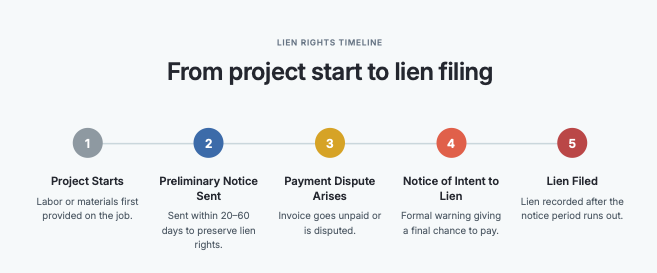
A preliminary notice (also called a notice to owner, notice of furnishing, or pre-lien notice) is a written notice sent early in a project (typically within 20 to 60 days of first providing labor or materials) that tells the property owner, GC, and sometimes the construction lender that you're on the job. In states that require one, sending it late can forfeit your lien rights outright for the work performed before the notice went out.
This step trips up subcontractors more than any other part of the lien process, because it doesn't feel urgent at the time. Nothing's wrong yet. No one's late on payment. But by the time a dispute surfaces, the preliminary notice window has often already closed, and you can’t send it retroactively.
Don’t confuse a preliminary notice with a notice of intent to lien (NOI):
- A preliminary notice goes out at the start of a job, before any dispute exists.
- An NOI comes later. It's a formal warning sent after a payment problem shows up, giving the property owner or GC one last chance to pay before you file.
Some states require an NOI as a prerequisite to filing, and sending one doesn't extend your filing deadline, so build it into your timeline rather than treating it as a delay tactic.
For the specific notice deadlines and requirements in your state, see Siteline's by-state guides on preliminary notice requirements and notice of intent to lien requirements.
How do I file a mechanic's lien?
Once you've confirmed preliminary notice isn't an issue—or you’ve properly submitted that document—and payment still hasn't come through, here's how the lien filing process typically works:
1. Confirm you're eligible and within your deadline.
Start with these two things:
- That your role qualifies you to file (most states allow GCs, subs, lower-tier subs, and suppliers to file, although a few limit lien rights to parties in direct contract with the GC).
- That you're still inside your state's filing window.
That window typically runs from your last furnishing date (the last day you provided labor or materials) or project completion, and it can be as short as 45 days or as long as several months, depending on the state.
2. Gather the required information.
Pull together the property owner's legal name and the property's legal description (not just the street address), the GC's information, a description of the labor or materials you provided, and the total amount owed, including any unpaid retainage. An inaccurate property description is one of the most common ways a lien gets challenged.
3. Prepare the lien document.
Every state has its own mechanic's lien form (sometimes called a lien claim, claim of lien, or lien affidavit) with its own required language. Using a generic template, or one for a different state, is a common, avoidable mistake. Pull the correct form for the state where the property sits, not where your business is based.
4. Get it notarized if your state requires it.
Most states require it. Siteline's own state-by-state review found that 36 states plus Washington, D.C., require a mechanic's lien claim to be notarized before it's recorded. Note that's a separate requirement from lien waiver notarization, which only Mississippi and Wyoming mandate by law. See the full state list of notarization requirements in our blog post, “Understanding When to Notarize Documents in Construction.”
5. File it with the county recorder.
Record the lien with the county recorder or clerk's office in the county where the property sits, not where your company, the GC, or the owner is based. Filing typically involves a few line items:
- a county recording fee that varies by county and page count,
- certified mail or courier costs to serve the required parties, and
- preparing a proof-of-service affidavit if your state requires one.
Most offices accept filings in person, by mail, or electronically.
6. Serve the required parties.
Recording puts the lien in the public record, but most states also require that you formally serve notice of the filing on the property owner (and sometimes the GC) within a set number of days. Serving the wrong party—or serving one incorrectly—can undermine an otherwise valid lien. It's also worth sending copies to other interested parties, like the lender, even when it's not strictly required.
7. Know your enforcement window.
Filing preserves your claim; it does not collect the money. Every state sets a separate enforcement deadline—i.e., the window to file a foreclosure lawsuit before the lien lapses—ranging from 90 days to two years depending on the state.
For the full breakdown of what enforcement looks like, see “What Happens After You File a Mechanic's Lien?”
Are there mechanic's lien deadlines?
Three separate deadlines govern every mechanic's lien, and each one runs on its own clock.
- Notice deadline: If your state requires a preliminary notice or NOI, each has its own deadline. Preliminary notice deadlines usually fall 20 to 60 days from when you first provide labor or materials, while an NOI must be sent a set number of days before filing. Miss a required notice deadline and you could jeopardize your lien rights.
- Filing deadline: This is the window to record the lien itself, typically measured from your last furnishing date or from project completion. It runs as short as 45 days in Hawaii and as long as 8 months in New York for commercial projects.
- Enforcement deadline: Once filed, you have a separate window to enforce the lien through a foreclosure lawsuit, or it lapses. This ranges from only 90 days in states like Massachusetts to six years in Ohio and South Dakota.
None of these deadlines extend or pause for the others. For instance, sending an NOI doesn't buy you more time to file. If your state gives you 90 days to file and requires a 10-day NOI, you effectively need to send that notice by day 80.
The trap most subcontractors fall into isn't misunderstanding any single deadline. It's tracking three different clocks, across multiple projects and states, without a system built for it.
Does filing a mechanic's lien vary by state?
Mechanic's lien law is state law, and the differences go well beyond deadlines. Before you file—or better, before you start a project—confirm requirements for the state where the property is located, because the variation is significant. Below is a quick look at how a handful of states compare.
Note that these are general examples, not a complete picture. State lien laws change, and rules often differ between GCs, subcontractors, and suppliers. Confirm current requirements for your state.
What happens after I file a mechanic's lien?
Filing the lien starts a new clock rather than ending the process. Once recorded, the property owner gets notice and an enforcement deadline begins. In practice, that's often enough to get a stalled payment moving, since most disputes resolve through negotiation once the owner sees the lien on record. If it doesn't resolve, you'll need to file a foreclosure lawsuit before the enforcement deadline passes, or the lien lapses.
We cover that full process in “What Happens After You File a Mechanic's Lien?”
How do I stay lien-ready across every job?
Subcontractors who never have to scramble over a lien deadline are usually the ones who treated lien rights as part of routine billing from day one, not as a last-resort legal maneuver.
That's the idea behind Siteline's Lien Rights Management. Instead of managing deadlines in a separate spreadsheet, Siteline tracks preliminary notice, NOI, filing, and enforcement deadlines for every active project, based on the specific state and role, right alongside your billing and collections workflow.
Site Landscape Development, a Texas-based, 300+ employee commercial landscaping company, used to lean on strong GC relationships instead of sending formal lien notices. That approach held up until a longtime customer's payment pattern shifted, and the team realized it had waited too long to protect its payment rights. Since adopting Siteline, the company now monitors $30.3 million in contract value for lien deadlines, leveraging a prioritized list of at-risk projects with Siteline. The software also applies the correct deadline based on progress payment or retainage, removing another time-consuming manual step.
Eliminate risk and uncertainty, and bring lien protection into the same workflow as billing and collections with Siteline. Book a demo now.
Other Frequently Asked Questions
Who can file a mechanic's lien?
In most states, GCs, subcontractors, lower-tier subcontractors, material suppliers, and equipment lessors can all file, so long as they follow that state's requirements. A handful of states, including Pennsylvania, limit lien rights to parties in direct contract with the GC. Confirm eligibility under the law of the state where the project sits.
How long do you have to file a mechanic's lien?
It depends on the state and your role. Filing deadlines typically run from your last furnishing date or project completion, ranging from as short as 45 days (Hawaii) to as long as 8 months (New York) for commercial work. Confirm the current deadline for your specific state and role before relying on a general timeline.
Do you need a lawyer to file a mechanic's lien?
Not always. Some states let contractors file the initial claim without an attorney, though the form must still meet every statutory requirement exactly. If the lien doesn't resolve payment and you need to enforce it through foreclosure, many states require a licensed attorney, so it's worth getting legal guidance well before that point.
What's the difference between a mechanic's lien and a lien waiver?
A mechanic's lien is a claim you file to secure payment. A lien waiver is the opposite: a document you sign giving up your right to file a lien for a specific payment, depending on the waiver type. Signing an unconditional waiver before payment clears can forfeit your lien rights on work you haven't been paid for yet.
Does filing a mechanic's lien hurt my relationship with the GC?
It can strain it in the short term, but most experienced GCs treat liens as a normal part of the industry's payment structure, not a personal attack. Sending notices well before filing and communicating clearly about the outstanding balance tends to preserve the relationship better than staying quiet and filing without warning.
Can I recover attorney's fees if I win a mechanic's lien case?
It depends on the state. Most states follow the "American Rule," where each side pays its own attorney regardless of who wins, so a successful foreclosure doesn't automatically cover your legal costs. A smaller group of states, including Florida, Texas, and Washington, let the prevailing party recover attorney's fees by statute. Confirm current rules for your state before deciding whether litigation is worth pursuing, since it can significantly change the economics of enforcement.
AIA®, G702®, and G703® are registered trademarks owned by The American Institute of Architects and ACD Operations, LLC. Siteline is not affiliated with The American Institute of Architects or ACD Operations, LLC. Users who wish to use Siteline’s software to assist in filling out AIA® forms must have or secure the AIA® forms. Siteline does not and will not provide users with the forms.


%202.webp)