.svg)
Winning work isn't automatically good for your business. Every job you take means fronting labor, materials, and overhead for 60, 90, or sometimes 180 days on the trust of a company’s willingness to pay. That makes every subcontract a credit decision—one that most subs make without pulling a single piece of financial information on the party they're extending credit to.
On the first episode of Billing & Chilling, Tara Cristel—co-owner of Total Glass, a glass and glazing subcontractor based in Illinois—shared how she learned that the hard way. With a general contractor (GC) months behind on payment and her company's survival in question, she went looking for financing. The lenders she called asked for a list of the GCs she worked with, and within the hour, came back refusing to lend against three of them—the same ones she was fighting hardest to collect from.
The experience completely reframed a process she'd only ever experienced from the other side. "If they can ask us those questions because they want to protect their company, then I should be able to ask the same questions because I want to protect my company," she says. Today, Cristel prequalifies every new GC before deciding whether to take their work. It’s a simple idea, but still far from standard practice in construction.
Prequalification runs one direction, and it shouldn't.
Subcontractors already know the prequalification drill—just from the other side of the judge’s table. Before awarding work, GCs routinely ask for financial statements, bonding capacity, safety records, workforce numbers, and experience on similar scopes. Increasingly, third-party prequalification platforms are part of that process, too.
Martin Press, owner of Press Mechanical Contractors and a national board officer with the American Subcontractors Association (ASA), made a similar case on another episode of Billing & Chilling (airing September 29th). Press is a firm believer in prequalification and the role it plays in helping GCs manage risk. He argues that subcontractors have both the ability and the responsibility to make informed choices about who they work for.
That matters in an industry where subcontractors can have significant amounts of their own cash tied up while they wait to get paid. In The State of Subcontractor Billing in 2026, 92% of subcontractors said they had floated payroll out of their own pockets while waiting for payment. Twenty-eight percent did it most months.
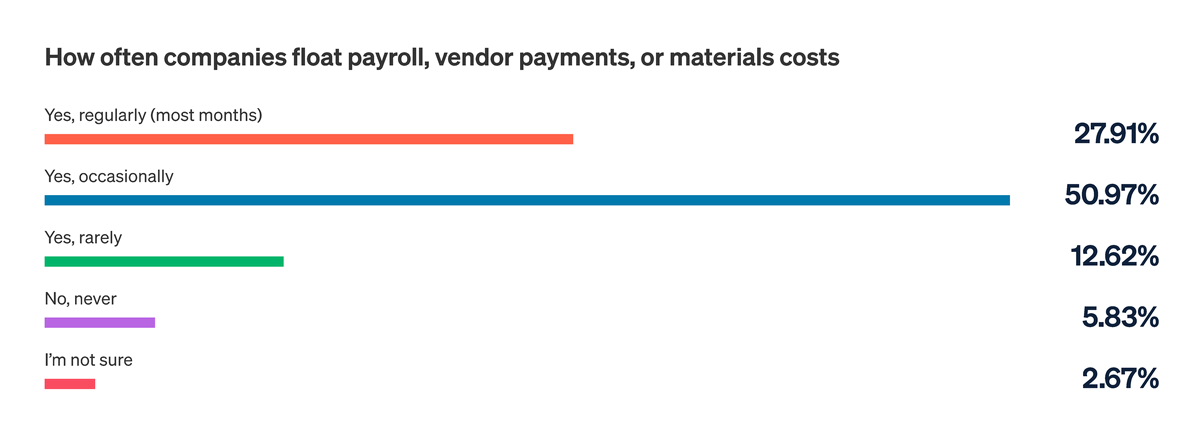
With that much of their own money on the line, subcontractors have every reason to scrutinize the companies they’re extending credit to, too.
The 9-Point GC Prequalification Checklist
But how do you put that due diligence into practice? Here are nine ways to vet a GC before you commit.
1. Pull their business credit report.
You don't need a lender—or the GC itself—to ascertain a company's creditworthiness. As Cristel discovered, business credit works differently from personal credit: you can pull a company's report for a small fee without its permission. The three major bureaus are Dun & Bradstreet, Experian Business, and Equifax Business.
Each bureau uses its own data and scoring model, but their reports can give you a broader picture of how financially risky doing business with a company may be. That can include payment behavior, credit risk, financial strength, and the likelihood of serious delinquency, business failure, or bankruptcy. Because the bureaus collect from different lenders, vendors, and public sources, a GC's profile can also vary from one bureau to another—so checking more than one can give you a fuller picture when the stakes warrant it.
2. Send them the same questions they send you.
Since you already have a prequalification form in your files—the one they made you fill out—send back a version of it.
Ask for what they ask of you: audited or reviewed financials, bonding capacity and surety contact, a bank reference, average days to pay subcontractors on the last three projects, current backlog, and how the project is funded.
How they answer will tell you a lot, but whether they answer at all will tell you more. Cristel's read on it: "The good general contractors will not care. And the ones who I probably don't want to work with are probably going to care."
3. Check their track record with other subcontractors.
The GCs you already know are easier to evaluate. It's the unfamiliar ones—especially out-of-state contractors coming into your market for a single project—that require more digging. Other subcontractors are often your best source of firsthand information.
Ask the subs standing next to you on your current jobs which GCs they've worked for, what the experience was like, and whether they'd work for them again. They can tell you things no credit report or reference list will—from how well a GC communicates when problems come up to whether the reality of working for them matches what you were promised.
Your industry network gives you another place to ask those questions. Dick Roberts, president of DTR Landscape Development and Press's fellow guest on Billing & Chilling, uses his ASA network to vet GCs he hasn't worked with before. At chapter mixers and events, he'll ask other members: “Have you done any work for them? What were they like? Did you get paid on time?”
4. Dig into the GC’s payment patterns.
That last question is particularly important. A GC can pay every bill eventually and still put significant pressure on your cash flow if it consistently takes 60, 75, or 90 days to do it. For GCs you've worked with before, check your own time-to-payment data to see which GCs routinely stretch the cycle, and use it to determine how much risk you're willing to carry with them on the next job.
For GCs you haven't worked with, peer experience again becomes especially useful for filling that gap—and potentially some of the data found in the credit reports. And if you're evaluating a larger contractor, Siteline's “50 Fastest-Paying GCs in Commercial Construction” gives you another benchmark for how quickly some of the country's largest GCs actually pay their subcontractors.

5. Look at their safety record and culture.
When Roberts runs through his mental checklist for a GC, payment comes first. Safety comes second.
GCs routinely evaluate subcontractors' safety records before handing them work, so turn that diligence around. Search the GC in OSHA's Establishment Search to review its inspection and citation history. Look for patterns in the types and severity of violations, keeping in mind that OSHA records are tied to individual establishments and worksites rather than providing a single companywide safety score.
Then ask the GC directly about the project: who's responsible for site safety, what its safety requirements are, and how incidents and hazards are handled. You're not just trying to determine whether the GC has a safety program; you're trying to understand the environment your crews will actually be working in.
6. Ask for the prime contract.
Your subcontract incorporates terms from the prime contract, so ask to see it, even if the GC will only hand over a redacted copy. Press asks without exception. "I ask for the prime contract 100% of the time. If they won't provide it, we strike the references to the prime contract from our subcontract agreement, as many as 56 times." That leaves the GC a choice: produce the redacted prime, or watch every reference to it disappear.
When you get it, read the payment timing, retainage, change order requirements, and schedule obligations you'll inherit. But the prime isn't only about what flows down to you. It's also a window into the owner and the conditions the GC itself is working under. Press points to a university in Washington, D.C., whose prime gives the owner 90 days to review payment before releasing funds, which settles the question for him no matter who holds the contract: "I'm not going to work for that owner. I don't care who the GC is."
If a GC won't show you the terms, press for why. Ultimately, you'll need to decide if not being able to review the terms is a risk you want to take with that job.
7. Read the subcontract for risk transfer.
The subcontract tells you how much of the project’s risk the GC expects you to carry. Read it closely before you sign, paying particular attention to provisions that affect your right to payment, liability, ability to stop work, and recourse if something goes wrong. That includes:
- Pay-if-paid and pay-when-paid language
- Indemnification
- Retainage
- Suspension and termination rights
- Change order requirements
- Lien provisions
And don't assume any terms you negotiate will make it to the final agreement. Cristel used to include her own conditions in Total Glass's proposals. She later discovered language elsewhere in a GC's subcontract that wiped those conditions out entirely.
"They had a little clause that was somewhere completely different in the contract, not even anywhere near the proposal, that said that any terms on the subcontractor's proposal were null and void upon signing of this contract. And I did not even know that,” Cristel explained.
8. Pay close attention to how they handle change orders, in particular.
Change orders account for 10–15% of total contract value on major projects, and on some jobs they run to 25% or more, which makes a GC's change order process one of the largest single variables in whether you collect. Roberts ranks it in his top three, right behind payment speed and safety.
Change order requests come in as an emergency, so you do the work immediately to keep the next trade from getting held up, and then you spend two months chasing the paperwork before you can bill for any of it.
Ask how field directives get documented, who signs, and what the typical turnaround is from direction to executed change order, then ask other subs the same question and compare answers.
Bonus: Pay attention during bidding.
Not everything you learn about a GC comes from a credit report, a reference check, or a prequalification form. The bidding process offers its own clues.
Repeated rebid requests are the ones Cristel watches. Total Glass has had GCs come back repeatedly, asking the company to remove scope, change specifications, or reprice the same work, and on one school project her husband rebid the job six or seven times. "It's hours and hours and hours of time that's already on the project before you've even signed a contract for it," she says.
In her experience, it usually means the project is costing the GC more than expected, and they're looking downstream to bring the number back down. That doesn't make every rebid a red flag, since projects change and bids change with them, but when a GC keeps coming back for another round, find out why.
Keep the file open.
Prequalification isn't a gate a GC passes through once. The research you do upfront gives you a read on the risk before taking the work, but your own experience with a GC gives you another layer of information, becoming a key part of how you evaluate the next opportunity.
But… that only works if you're capturing it. Press assumed his average time to payment ran 35 to 45 days, and Siteline showed him it was considerably longer. Its Customer Management view keeps average time to payment beside contract value, outstanding balance, and past-due amounts for every GC you bill, so the next time one of them calls, you're deciding from your record rather than your impression.
To see how Siteline turns your billing history into a clear picture of which GCs pay, which ones stall, and which ones to think twice about, schedule a demo.
Frequently Asked Questions
How do you prequalify a general contractor?
Pull the GC's business credit report, send back the same prequalification questions it asked of you, check its track record with other subcontractors in your market, review its payment history and average days to pay, search its OSHA inspection record, and read both the prime contract and the subcontract for terms that shift risk onto you. The goal is to price the risk accurately, not to disqualify the GC, necessarily.
Can I run a credit check on a general contractor?
Yes. Business credit reports don't require the subject's permission the way personal credit reports do, so you can pull one on a GC before you bid or before you sign. Dun & Bradstreet, Experian Business, and Equifax Business each sell reports on commercial entities, and because they draw on different sources, a GC's profile can differ between them.
How do I find out if a general contractor pays on time?
For GCs you've billed before, check your own time-to-payment data rather than trusting memory. For new GCs, ask other subcontractors on your current jobs and through your association chapter, and look at what the credit report says about payment behavior. Siteline's 50 Fastest-Paying GCs in Commercial Construction is a useful benchmark for larger contractors.
How can I check a general contractor's safety record?
Search the company in OSHA's Establishment Search to review its inspection and citation history, looking for patterns in the type and severity of violations. OSHA records are tied to individual worksites rather than to a single companywide score, so pair that with direct questions about who runs safety on your project and how incidents get handled.
Is it reasonable to ask a GC for their prime contract?
Yes, especially since your subcontract incorporates the prime's terms. Some GCs hand over a redacted copy without issue, while others refuse outright. Where refusal is standard, one alternative is striking every reference to the prime from your subcontract and letting the GC decide which it would rather do.
What are the biggest red flags when evaluating a general contractor?
Watch for refusal to share any financial or prime contract information, repeated rebid requests after your number is in, a pattern of serious OSHA violations, an undocumented or slow change order process, and heavily one-sided pay-if-paid, indemnity, and suspension language.
AIA®, G702®, and G703® are registered trademarks owned by The American Institute of Architects and ACD Operations, LLC. Siteline is not affiliated with The American Institute of Architects or ACD Operations, LLC. Users who wish to use Siteline’s software to assist in filling out AIA® forms must have or secure the AIA® forms. Siteline does not and will not provide users with the forms.


%202.webp)