.svg)
Key Takeaways
- Only 5% of subcontractors report getting paid on time, and the average wait is approximately 96 days from invoice submission to payment received.
- A/R balance shows what is owed; time to payment shows how long collection actually takes — a critical distinction for cash flow management.
- When payment cycles lengthen, subcontractors must float payroll, vendor bills, and overhead costs without reimbursement, squeezing working capital.
- Tracking time to payment by client and project type allows subcontractors to identify slow-paying GCs and make smarter bidding decisions.
Most subcontractors know their A/R balance. They know who owes them money, roughly how much is still out there, and which invoices are starting to age. But there’s a question A/R doesn’t answer: how long does it actually take to get paid?
For many subcontractors, the wait is much longer than it should be. In fact, most subcontractors wait about 96 days to get paid, and only 5% report getting paid on time.
A subcontractor can be busy, profitable on paper, and still feel squeezed if cash is slow coming in. That’s why time to payment matters. It gives construction finance teams a clearer view of how quickly billing turns into cash and where that process may be breaking down.
What is time to payment?
Time to payment is the average number of days it takes to turn a submitted invoice or pay app into cash received.
The formula is simple:
Payment Date – Billing Date = Days to Payment
How is it different from A/R Aging and DSO?
They all live in the same world, but each one measures something different—and that changes how you act on the data.
- A/R tells you how much is unpaid—it’s the balance.
- DSO, or days sales outstanding, is the broader company-level metric that rolls up payment timing across the business.
- Time to payment gets more operational. It shows how long billing actually takes to turn into cash on a specific customer, PM, or office, so it’s easier to pinpoint where that process is slowing down.
Put all three together and you get a far more complete picture of your cash flow than any one metric can provide on its own.
Why does time to payment matter?
When time to payment stretches, cash flow tightens. The longer it takes for money to come in, the longer your business has to float payroll, vendors, overhead, and project costs without getting reimbursed. Even if revenue looks good on paper, slow payment cycles can still create real pressure. And that pressure adds up fast.
As working capital gets tighter, forecasting gets harder to trust and teams lean more on reserves or credit lines than they’d like. As a result, growth gets harder to support because more work often means more cash tied up between billing and payment.
Think of it this way: two subcontractors with the same open A/R balance. On paper, they may look identical. But if one usually gets paid in 35 days and the other in 75, they’re living completely different cash flow realities. The former is turning work into cash at a healthy pace, while the latter is carrying more pressure, more uncertainty, and usually more risk. Time to payment is where that difference shows up—and where teams can actually do something about it.
The other challenge is that slow payment cycles usually are not spread evenly across the business. Some customers are just slower than others. Some PMs are tied to jobs where billing gets delayed or follow-up falls apart. Some offices run a tighter process and move cash faster. Others create drag. And if you can’t see those patterns, you can’t really fix them.
What slows time to payment down?
Usually, it is not one giant issue. It’s a bunch of smaller ones stacking up across the process.
- Billing goes out late.
- Documentation is incomplete or missing.
- Internal inputs come in slowly.
- Approvals drag.
- The customer pays slowly.
- Collections follow-up happens too late.
None of that is unusual in construction. But when those things happen repeatedly they quietly stretch the time between billing and cash. That is why time to payment is such a useful metric to track. It gives you a way to spot where time is getting lost instead of just feeling the pressure and guessing at the cause.
How do you put time to payment data to work?
One invoice does not tell you much. The real value comes from building a complete picture over time, and that starts with these four habits:
- Average it across invoices: That average becomes the baseline everything else stems from—what you segment, what you trend, and what tells you whether things are actually improving.
- Break it down by customer, PM, office, or project type: This is where patterns emerge and you start to see who's creating drag.
- Track how it moves over time: Is your average improving or getting worse? A shift in the wrong direction is often the first sign of a problem.
- Watch for outliers: A customer who suddenly starts paying slower deserves attention even if their balance still looks fine.
Maybe one GC consistently pays slower than everyone else. Maybe one PM’s jobs always seem to lag because billing packages go out later. Maybe one office is doing a much better job getting clean invoices out the door the first time. Those are the kinds of insights that actually help you improve cash flow.
A lot of teams try to pull this together in spreadsheets. And sure, that can work for a while. But once you want to trend it, compare groups, and spot outliers across the business, it gets messy fast.
Here are six practical ways to improve time to payment.
Once you can see where time is slipping, you can do something about it. In most cases, the biggest improvements come from tightening the process, not just pushing harder on collections at the end.
1. Standardize billing timelines.
Inconsistent billing creates inconsistent cash flow. If one PM gets inputs in early, another gets them in late, and a third waits until the last possible second, your billing process is already creating unnecessary variability before a pay app even leaves the building.
Standard timelines for gathering inputs, reviewing pay apps, and submitting billing packages help reduce avoidable lag before an invoice even leaves the building.
2. Clean up inputs before submission.
A billing package that goes out incomplete or incorrect is one of the fastest ways to slow payment down. Missing backup, incorrect values, missing waivers, and wrong forms all create friction. The cleaner your billing package is on the first pass, the better your odds of keeping payment moving.
In other words, time to payment doesn’t just depend on when you bill. It depends on whether what you sent was actually ready to be paid.
3. Track payment behavior by customer, not just by balance.
Some customers pay slowly because something went wrong. Others pay slowly because that is just how they operate. If you only look at open balances, you miss the pattern. Tracking time to payment by customer helps you see which accounts consistently stretch the cycle and which do not. That can shape everything from collections strategy to forecasting assumptions to how much risk you are willing to carry with a given customer.
4. Prioritize collections based on patterns.
Collections should not just be driven by the biggest balances. They should also account for who’s slowing down, who’s drifting beyond normal behavior, and where delays are becoming a pattern. A customer with a moderate balance and worsening payment timing can be just as important to act on as one with a large overdue amount.
Time to payment gives collections teams a better signal for where to focus first.
5. Fix the workflows around the invoice.
Payment delays do not always start with collections—they often start earlier. Compliance issues, missing documentation, delayed approvals, and lien waiver bottlenecks can all slow down the path from billing to cash. If you want to improve time to payment, you have to look beyond the invoice itself and tighten the back-office workflows connected to it.
This is one of the most underappreciated aspects of this metric: it points to where process quality is affecting cash flow, not just where money is sitting.
6. Stop piecing it all together manually.
A lot of payment delays stay hidden because no one has a single, clean view of what is happening across the portfolio. Teams know there is a problem—they feel it. But they are piecing it together from spreadsheets, inboxes, aging reports, and institutional knowledge. That makes it much harder to spot trends early or respond consistently.
Visibility is what makes improvement possible. When teams can clearly see where time is slipping, they can fix the right issue faster.
Where does Siteline fit in?
Siteline’s Time to Payment Dashboard is built for exactly this. It helps teams track average days to paid, monitor trends over time, and see which customers, PMs, or offices are slowing payment cycles. That kind of early-warning visibility matters that makes it possible to act before delays compound into something bigger.
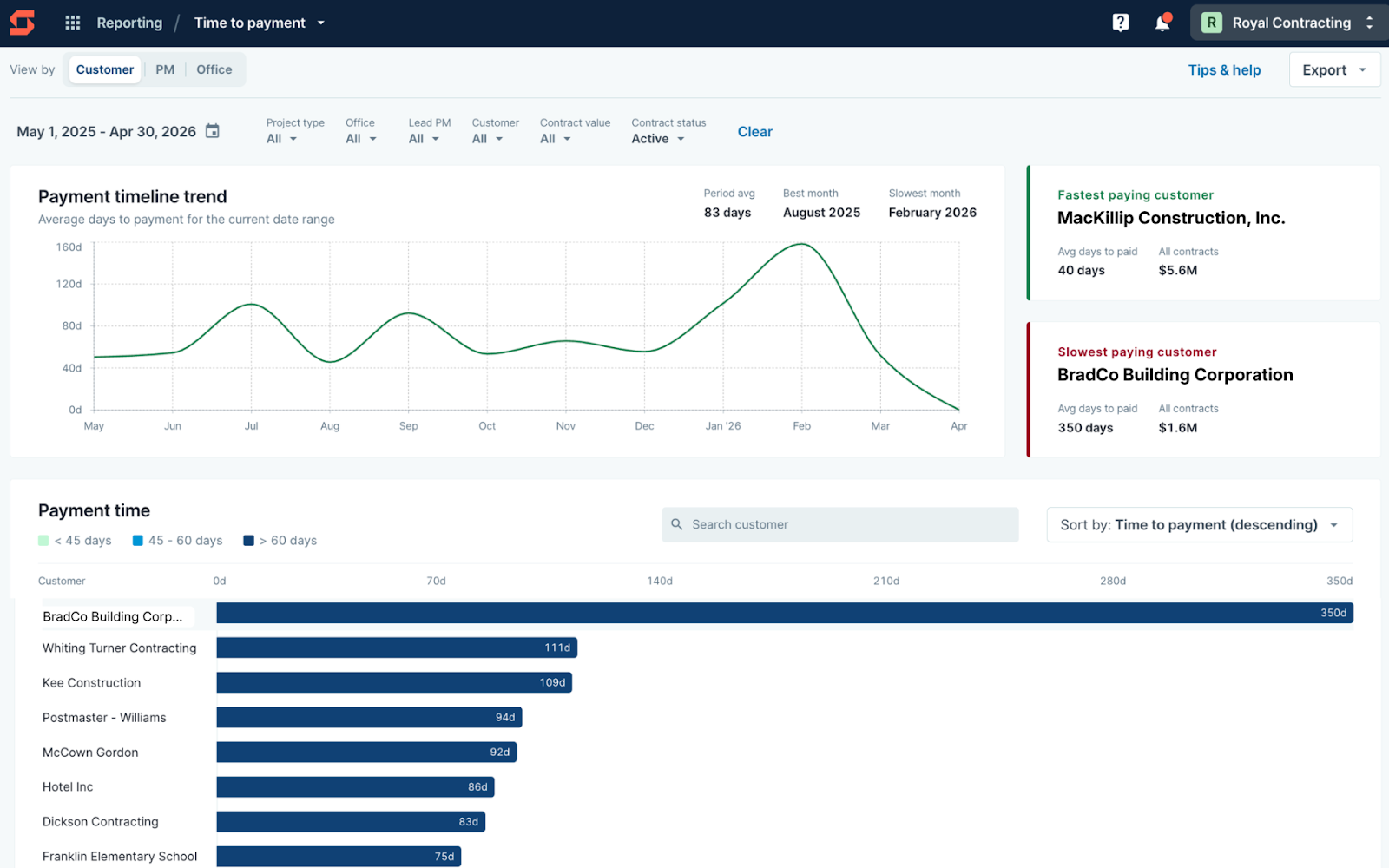
Across nearly $14B in tracked receivables, Siteline customers collect payment in an average of 55 days—measured from pay app submission to payment recorded in Siteline, compared to the 96-day industry average. If you're losing sleep over slow payments, schedule a demo to see how Siteline can help you get paid faster—starting with the Time to Payment Dashboard.
AIA®, G702®, and G703® are registered trademarks owned by The American Institute of Architects and ACD Operations, LLC. Siteline is not affiliated with The American Institute of Architects or ACD Operations, LLC. Users who wish to use Siteline’s software to assist in filling out AIA® forms must have or secure the AIA® forms. Siteline does not and will not provide users with the forms.


%202.webp)