.svg)
Key Takeaways
- Subcontractors now carry most of the risk on a project, yet slow pay and lopsided terms are still treated as fixed when many are more negotiable than they look.
- Payment timing alone can decide whether a job makes money: For one $1.25M job, waiting 90 days instead of 30 more than doubled the cash tied up and cost about half the profit.
- Project managers have more influence over cash than most companies realize, but not all are trained on the financial side of the job.
- GCs respond to subs who know their real costs and can explain them, so the strongest asks are the ones backed by numbers you can defend.
I spent last week at SUBExcel, the American Subcontractors Association's (ASA) annual conference, and one moment I keep coming back to was during a session on cash flow. Maxim Consulting Group’s Stephane McShane was explaining how much cash a single job can tie up when a contractor sitting near me admitted that he knows his numbers are bad, which is why he doesn't look at them.
I understood where he was coming from. There's a long-standing sentiment in construction that slow pay and lopsided terms come with the territory and that a subcontractor's job is to just deal with them. But Stephane, who I've seen present a few times now, consistently pushes back on that idea. She always inspires me. I agree with her that subcontractors have more control than they may think—but exercising it starts with understanding exactly where they stand.
By the end of her session, I was wondering how much of “the way things are” survives simply because so few of us look closely enough to challenge it.
Subs ended up with all the risk.
It helps to remember how we got here. There was a time when architects sat in the driver's seat on a project, until they began pushing risk down to general contractors (GCs), who took the wheel because they were the ones carrying it. Over the last few decades, GCs have passed much of that risk along to their subs, so the companies hiring the labor, buying the material, and floating payroll while they wait to get paid now have the most exposure and often the least say.
If you're carrying the risk, you've earned a turn in the driver's seat. Taking it, though, requires knowing your numbers well enough to know what to ask for.
You can’t ask for what you can’t see.
The slide that got the room's attention showed the same $1.25 million job, with the same $70,000 in profit, under three payment timelines. Paid in:
- 30 days, the job tied up about $312,000 of the contractor's cash at its peak.
- 60 days, that figure rose to $560,000.
- 90 days, it passed $759,000.
Stephane then priced that cash at the 12% return it could have earned elsewhere, which put the cost of waiting 90 days at roughly $35,000, or half the job's profit.
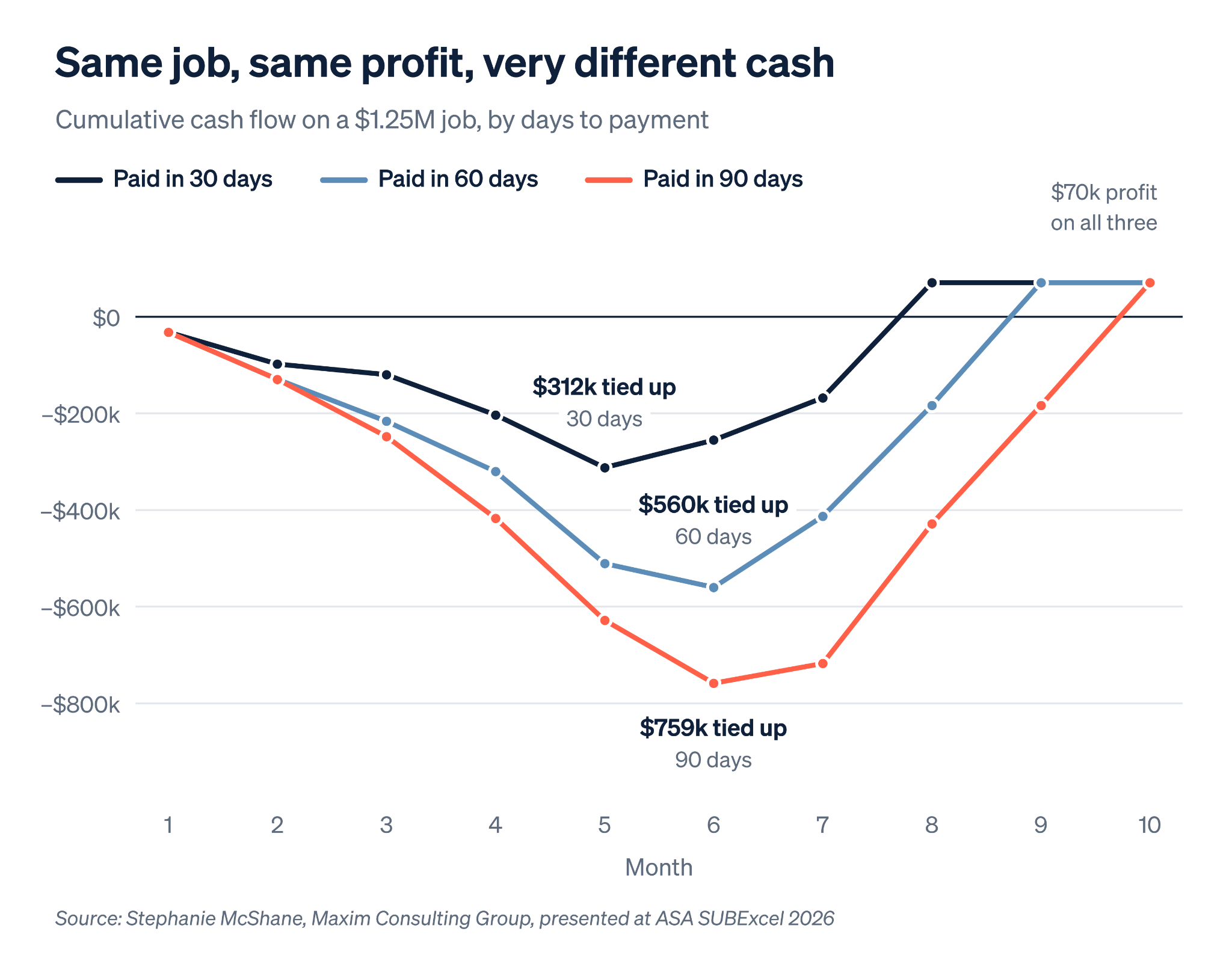
That's why it’s so critical for cash to be visible at the job level—not just on the company's balance sheet. When you know which month a job turns cash positive, you can plan around the months it won't be, and once you've run a few similar jobs, you have a benchmark that tells you whether the next one is on track. I've heard owners say that gut instinct can carry a contracting business up to a certain size, and that somewhere past that threshold, "we'll figure it out" stops working as a strategy.
Stephane also pushes her clients to bill ahead of their costs, and given how long subs wait to get paid, I'm all for it. I always encourage subcontractors to weight the schedule of values (SOV) toward the work that happens first, such as engineering and prefab. The same goes for stored materials: bill for them as soon as you can. It requires additional documentation, but it’s worth it. You don’t want to wait until the material is installed to bill for it—and then the 60+ days it takes to actually get paid on top of that.
Whatever the case, make sure everyone understands what that money is, because cash you've collected against costs you haven't incurred yet is already spoken for. Treating it as profit is how a profitable job turns into a cash problem down the road.
Your PMs own more of your cash than you think.
Unlike CFMA conferences, which are more finance-focused, SUBExcel draws a lot more owners and operators. And as a former PM myself, it was exciting to see the field folks leaning into the discussions about cash flow because of how much of an influence they have over it. They know the job, have the relationship with the GC, and have the historical context to know when and where to push. Billing, change orders, and collections all go better when PMs see them as part of running the work—not something that belongs solely to accounting.
The catch is that a lot of PMs aren’t ever taught this side of the job. Stephane estimated that fewer than 10% of the PMs she works with account for overhead when they decide what to bill, which says more about how we train them than about the PMs themselves. Closing that gap takes showing PMs the cash position of their own jobs every month, explaining what the numbers mean, and repeating it more often than feels necessary.
It also means teaching the fundamentals before handing them to software, because a PM who never learned how a schedule of values (SOV) drives cash won't catch it if the tool gets it wrong.
Ask with numbers you can defend.
There's negotiation every single day on a construction project, and how you bill is part of it. Stephane urges subs to be firm about their SOV. I'll admit I listened to that part of her session with my old GC hat on, because I was usually the one telling subs how they'd bill. GCs are somewhat blind to a sub's real costs, so when a sub handed me their own breakdown, I'd lay it next to the other bidders' to see where the early line items had been padded, since that padding put us at risk. If a sub pushed back, though, I'd have them explain what they disagreed with, and we'd work through it from there.
That’s where knowing your real early costs—preconstruction, engineering, prefab, procurement—gives you something to stand on. If you can explain those costs in plain language, you’re not asking a GC for better terms; you’re just making a better case for them. And that can change how they see you. When Tara Cristel joined me on Billing & Chilling, she said GCs respected her more once she started negotiating her contracts, which matches what I saw from the other side of the table. A sub who couldn't explain its own numbers made me wonder whether the company would still be around in five years.
This is what we built Siteline for.
Seeing your cash, bringing your PMs into it, and asking with numbers you can defend all depend on the same thing: the field and the office working from the same facts. That's the gap we built Siteline to close. PMs update their billing in the same place accounting builds the pay app, so the person negotiating with the GC and the person following up on payment have the same picture of the job.
And while we can't negotiate your contract or make a GC pay on time, we do give you the information to make better decisions about both. You can see where your cash is, who owes it, and how long each GC actually takes to pay. You might still decide to take a project with a GC that takes 90 days to pay, but at least you’ll know that going in and can plan accordingly.
That visibility can have a real impact. Siteline customers get paid in 55 days on average, compared to the industry average of 90 days. That’s more cash available to put toward the next project, instead of sitting in someone else’s hands.
You don't have to ask alone.
None of this is easy to do in isolation, which is what I meant back in March when I wrote that construction will humble you. It's a big part of why I keep showing up to ASA. There’s strength in being in a room with other subs, comparing what you’re seeing, learning what others have successfully pushed for, and realizing that something you’ve always accepted as standard may not be so standard after all.
Industry benchmarks can do the same thing when you can't be in the room. In our 2026 State of Subcontractor Billing report, 43% of subs said they wait more than 90 days to collect retainage, compared with just 15% of GCs, which is one of the clearest examples of how unevenly the cash burden lands. But retainage—along with payment timelines and billing schedules—are all more negotiable than they look when you know your numbers, know what other subs are successfully asking for, and use both to make a case for better terms.
The worst a GC can say is “no,” which is where you're starting from anyway.

AIA®, G702®, and G703® are registered trademarks owned by The American Institute of Architects and ACD Operations, LLC. Siteline is not affiliated with The American Institute of Architects or ACD Operations, LLC. Users who wish to use Siteline’s software to assist in filling out AIA® forms must have or secure the AIA® forms. Siteline does not and will not provide users with the forms.


%202.webp)