.svg)
Free Lien Waiver Templates for Subcontractors (and How to Use Them)
What is a lien waiver, and why do they matter?
A lien waiver is a legal document that waives your right to file a mechanic’s lien for payments you’ve received—or expect to receive—throughout a project. It essentially functions as a payment receipt, but with legal consequences. (Need more details? Explore our comprehensive lien waiver guide.)
In a perfect world, lien waivers would be simple—sign, send, move on. But in reality, they’re one of the most misunderstood (and most delayed) parts of subcontractor billing. Every client has a different process. Every project introduces a new form or requirement. And in states without statutory waiver language, it’s on you to make sure the waiver is correct, complete, and sent at the right time.
Get it wrong, and two things can happen:
- Your payment could be delayed, or
- You inadvertently give up your lien rights.
That’s why we created these templates—they make lien waivers simple, consistent, and easy to use.
How do I know which lien waiver to submit?
Lien waivers are time-sensitive documents. The form you send signals one thing: Have you been paid yet—yes or no?
- If payment is still pending → Conditional
- If payment has cleared → Unconditional
That’s almost the whole decision tree. From there, the waiver type depends on where you are in the billing cycle—whether you’re billing progress work or closing out the job.
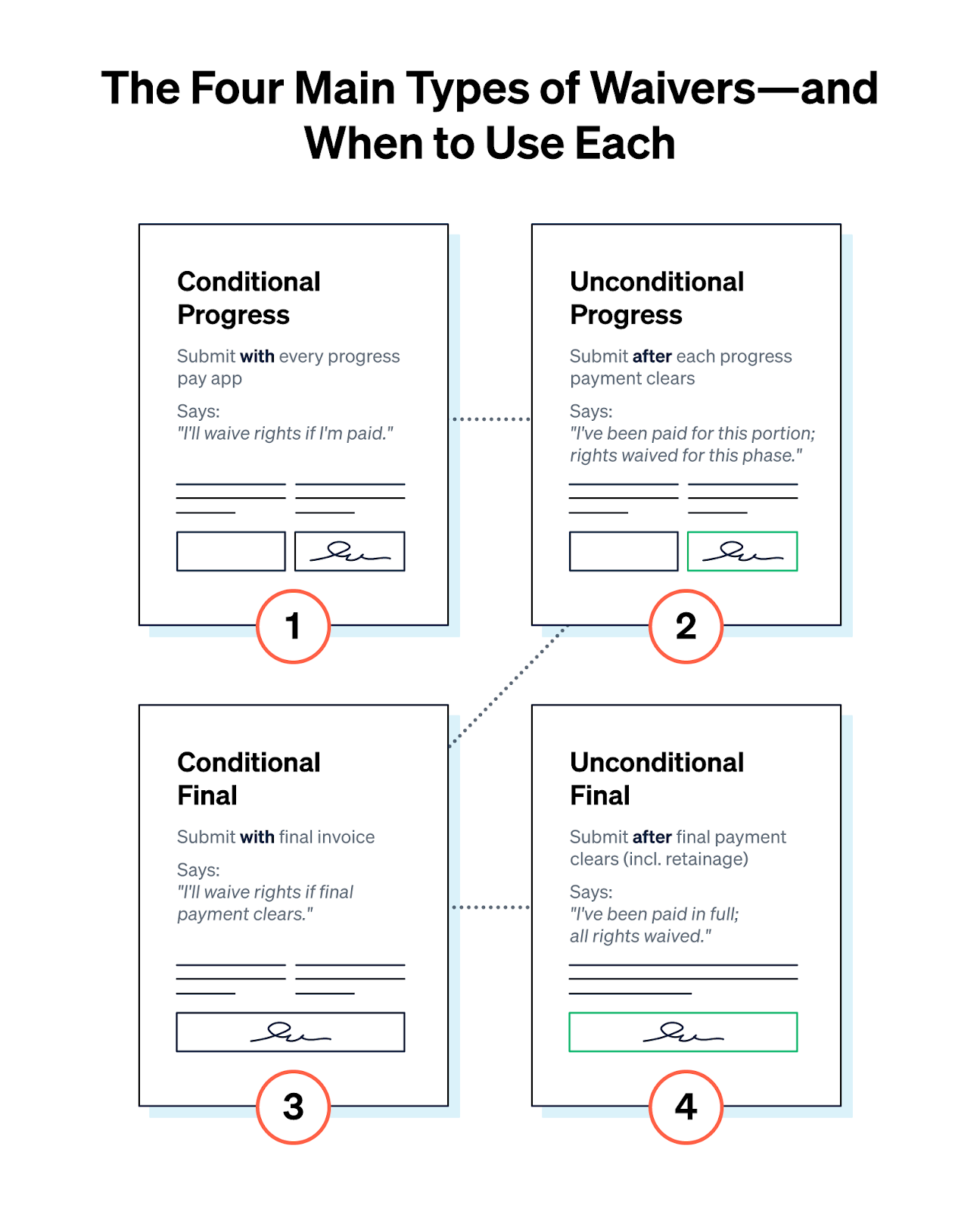
Together, those two filters (payment status and billing stage) create four lien waiver types:

1. Conditional Progress
When to use: Submit this with each progress pay app.
What it means: “I expect to be paid for this portion of work and will waive my lien rights for this amount once payment clears.”
2. Unconditional Progress
When to use: Submit this after the progress payment clears your bank.
What it means: “I’ve been paid for this portion of work and permanently waive my lien rights for that amount.”
3. Conditional Final
When to use: Submit this with your final pay app.
What it means: “Once you release final payment, including retainage, I’ll waive all remaining lien rights on this project.”
4. Unconditional Final
When to use: Submit this after final payment (including retainage) clears.
What it means: “Once you’ve paid me the final payment, including retainage, I’ll waive all my lien rights on this project.”
Here’s a quick visual to help put it all together:
How do lien waivers delay payment?
Most issues tied to lien waivers aren’t legal—they’re administrative. Mistakes like these can trigger a pay app rejection, often pushing your payment out until the next cycle:
- Using the wrong waiver type
- Lower-tier lien waivers are missing
- Wording doesn’t match what the client requires
- Incorrect project info, amount, or billing period
How do I avoid lien waiver mistakes?
To avoid mistakes that can delay payments, prep templates at the start of each project. Review the contract for waiver requirements up front, customize your templates, and keep them handy for each billing stage.
When you’re prepared, the more likely you are to:
- Submit complete billing packages on the first try (avoiding time-consuming revisions)
- Prevent pay apps from being rejected
- Keep payments flowing on a predictable schedule
- Speed up closeout and retainage release
How do I use these lien waiver templates?
These templates are designed as all-purpose lien waiver forms for construction projects. They’re easy to customize and follow standard formatting used across the industry.
However, there’s one critical exception: If your project is in one of the following states, do not use these templates: Arizona, California, Florida, Georgia, Massachusetts, Michigan, Mississippi, Missouri, Nevada, Texas, Utah, and Wyoming.
These states require statutory lien waiver forms, meaning the waiver language is set by law and cannot be modified. For those projects, use the state’s required form, which you can find in our lien waiver directory.
For all other states, here’s how to use the templates:
- Download the correct waiver (conditional/unconditional, progress/final).
- Remove the Disclaimer section and Important note from the top of the template.
- Insert your company letterhead at the top.
- Add project, client, and company details by typing directly on the lines—they’ll expand as you type.
- Attach conditional waivers to pay apps; send unconditional waivers only after funds have cleared.
- Include lower-tier waivers if required by the client. (They can also use these templates; the same timing rules apply.)
- Save as a PDF before sending to lock formatting.
- Keep a copy with your billing documentation.
Yes. If the client requires lower-tier waivers, they can use these same templates—just follow the same conditional vs. unconditional timing.
Yes. Signing an unconditional waiver before payment clears can waive your lien rights even if the check bounces. Always confirm payment before signing anything unconditional.
Not in most states. Only Wyoming and Mississippi require lien waivers to be notarized. Other than that, it’s up to the client’s discretion. (So again, make sure you review that contract.)
A conditional lien waiver is only effective once payment is actually received and clears your bank. An unconditional lien waiver is effective as soon as you sign it—regardless of whether the money clears. (Get the full breakdown in this blog post.)
Progress lien waivers apply to progress (or partial) payments during the project. Final lien waivers apply to your last payment, including retainage.
Use a conditional waiver when payment is still pending. Use an unconditional waiver only after funds have cleared. (More details on types and timing in this lien waiver guide.)
The following states require specific, legally mandated waiver language: AZ, CA, FL, GA, MA, MI, MS, MO, NV, TX, UT, and WY. Visit Siteline’s Lien Waiver Directory to find the correct form for your state.
DISCLAIMER: These lien waiver templates are for informational purposes only and do not constitute legal advice. Siteline is not a law firm. Users are responsible for verifying all state-specific requirements. If you have legal questions, consult a licensed attorney.